

INDUSTRIAL CYCLONES, VENTURI SCRUBBERS & SEVERE SERVICE PARTICULATE FILTRATION
Founded in Louisville, Kentucky in 1947, Fisher-Klosterman is a global leader in severe service particulate filtration — supplying custom-engineered industrial cyclones and venturi scrubbers for the world’s most demanding high temperature, high pressure, abrasive, and corrosive process environments for nearly eight decades. Where other equipment providers have fallen short, Fisher-Klosterman equipment has delivered effective, long-term air pollution control and product recovery across the most challenging industrial applications in the refinery, chemical, power, and heavy manufacturing industries worldwide. Fisher-Klosterman is a brand of CECO Environmental.
Fisher-Klosterman’s engineering heritage traces through several landmark innovations: the development of cyclone and scrubber technologies in the 1960s, the introduction of the high-efficiency XQ Cyclone in the 1980s — a design so effective it eliminated the need for downstream baghouse filtration in many applications and remains the primary industrial cyclone design in use today — and the subsequent acquisition of Buell, a respected name in refinery FCC cyclones and fluid bed applications. This foundation of over 75 years of application experience, engineering rigor, and quality control underpins every Fisher-Klosterman product manufactured today.
Trotter Equipment represents Fisher-Klosterman across Ohio, Indiana, Kentucky, and West Virginia. Our engineers combine Fisher-Klosterman’s world-class severe service application expertise and sophisticated cyclone design capabilities with Trotter’s deep regional field experience — helping customers select, specify, and support the right particulate control solution for every application, from standard dust collection through the most extreme process conditions.
Fisher-Klosterman Equipment
Fisher-Klosterman’s product line addresses particulate capture and removal across two core technology families — industrial cyclones and venturi scrubbers — both engineered specifically for severe service conditions where conventional equipment cannot achieve the required performance or service life. Every Fisher-Klosterman product is custom-designed to the specific operating parameters, particulate characteristics, temperature, pressure, and materials of construction required by each application.
Industrial Cyclones — XQ Series & Severe Service Designs
Fisher-Klosterman industrial cyclones use centrifugal force to capture, recover, and remove particulate from industrial gas streams — without filter media, without moving parts, and without the maintenance demands of fabric filtration. The XQ Series represents Fisher-Klosterman’s flagship high-efficiency cyclone design, offering seven basic models spanning a wide range of collection efficiencies to match specific application requirements. Sophisticated computer modeling allows guaranteed performance predictions when complete operating information is provided. Available in sizes from miniature bench-scale units through very large installations that must be shipped in sections and assembled in the field.
- XQ Series High-Efficiency Cyclones — Fisher-Klosterman’s primary industrial cyclone design, developed through extensive research and development in the 1980s to achieve collection efficiencies that in many applications eliminate the need for downstream baghouse or fabric filter equipment. Seven XQ models provide varying levels of efficiency to meet different collection requirements — from general-duty dust removal through ultra-high-efficiency fine particle capture in the 5–10 micron range. Single units or multiple arrangements (dual, quad, and larger banks) available to solve height restriction issues, increase collection efficiency, or increase throughput. Common inlet manifolds, outlet manifolds, and common hoppers available to simplify connecting ductwork on multi-unit installations. Constructed of carbon steel, stainless steel, or virtually any alloy steel required by the process.
- Severe Service Cyclones — High Temperature & High Pressure — Fisher-Klosterman’s severe service cyclone designs are engineered specifically for the most extreme operating conditions in industrial processing — including waste incineration, gasification, combustion processes, fluid bed reactors and regenerators, FCC reactor/regenerator service, chemical production, activated carbon systems, coking operations, cement and mineral processing, petrochemical reactors, drying and cooling processes, and kilns and calciners. Internal refractory lining systems allow operation at temperatures exceeding 2,000°F. ASME pressure vessel design and construction available for high-pressure service. Abrasion-resistant construction and linings for high-velocity erosive particulate streams. Heat transfer jacketing available where process temperature control is required.
- Standard Industrial Cyclones — Cost-effective general-duty cyclone designs for conventional dust collection and product recovery applications handling larger particles such as sawdust, metal shavings, grain dust, and similar bulk industrial dusts. Tangential inlet and moderate conical angle provide reliable separation at low capital cost and minimal maintenance for standard industrial applications. Available in carbon steel, stainless steel, or specialty alloys with a range of inlet and outlet configurations.
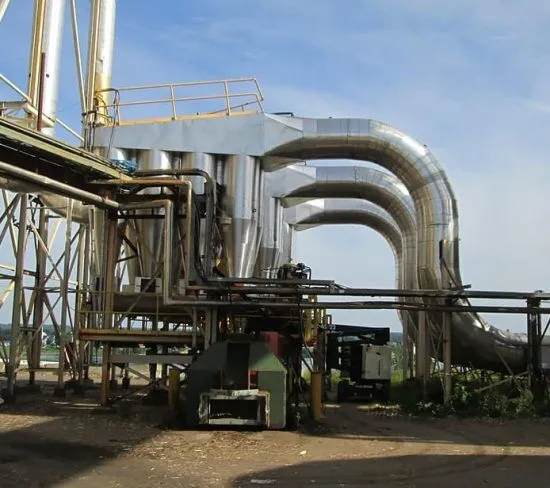
- Multi-Unit Cyclone Banks & Systems — For applications requiring high throughput, height-restricted installations, or staged collection efficiency, Fisher-Klosterman designs and fabricates multi-unit cyclone banks with common manifolding, shared hoppers, and integrated structural support. Multi-unit arrangements allow very large gas volumes to be handled within practical equipment dimensions while maintaining consistent separation efficiency across all units. Complete engineered systems including inlet ductwork, cyclone bank, collection hopper, discharge valve, and outlet plenum available as a single integrated package.
- Explosion Suppression & Venting Systems — All Fisher-Klosterman cyclone designs are developed with NFPA explosion containment and venting standards as a baseline requirement. Where the collected dust presents a deflagration hazard, cyclones are designed and constructed to exceed NFPA standards for explosion suppression or venting. Explosion isolation systems, rupture disc venting, and deflagration-rated construction options available for combustible dust applications in pharmaceutical, food, chemical, and other industries.
- Break-Apart & Cleanable Cyclone Designs — For applications requiring periodic internal inspection or cleaning — including pharmaceutical, food-grade, and specialty chemical service — Fisher-Klosterman offers break-apart cyclone construction that allows the cyclone body to be disassembled for internal access without cutting or major dismantling. Special pharmaceutical or food-grade interior and exterior finishes available to meet sanitary requirements.
MS Super Venturi Scrubbers & Wet Scrubbing Systems
Fisher-Klosterman MS Super Venturi Scrubbers use water or other scrubbing liquid to simultaneously capture particulate and absorb soluble gases from industrial exhaust streams — addressing applications where dry cyclone collection alone is insufficient, or where simultaneous gas absorption is required alongside particulate removal. The dirty gas stream is accelerated through a venturi throat where it collides with high-velocity scrubbing water, driving particle capture through impaction and diffusion. Contaminated scrubbing liquid is separated in a compact MS Series cyclonic separator and discharged to a recycle tank, with continuous purge to control solids concentration. All MS Super Venturi Scrubbers are performance-guaranteed and designed to surpass industry efficiency standards.
- MS Super Venturi Scrubber — The flagship Fisher-Klosterman wet scrubbing product, designed and refined over decades for reliable, high-efficiency simultaneous particulate and gas absorption service. Multiple throat designs, water injection configurations, and separator geometries are available to match the specific particulate loading, gas absorption requirement, and operating conditions of each application. Vertical or horizontal gas entry configurations to suit available installation space. Performance warranty provided when complete operating information is supplied. Constructed of carbon steel, stainless steel, nickel alloys, or fiber-reinforced plastic (FRP) depending on process chemistry and corrosion requirements.
- High-Temperature Quench & Scrubbing Systems — Integrated quench section upstream of the venturi scrubber for applications requiring gas temperature reduction before scrubbing — protecting downstream equipment and improving scrubbing efficiency. Particularly applicable to incineration, gasification, and high-temperature process exhaust streams where direct entry of hot gas into a standard scrubber is not possible. Quench section design matched to the specific gas temperature, flow rate, and moisture content of each application.
- Combination Particulate & Gas Absorption Systems — Venturi scrubber systems configured for simultaneous removal of particulate and soluble acid gases, alkali vapors, or other gas-phase contaminants in a single vessel. Common applications include HCl, HF, SO₂, H₂S, and ammonia absorption combined with particulate collection. Reagent injection systems, recirculation chemistry control, and pH monitoring integrated as part of a complete engineered package.
- Package Scrubbing Systems — Complete, factory-assembled scrubbing system packages including scrubber vessel, cyclonic separator, recirculation tank, pump, instrumentation, piping, fan, exhaust stack, and controls — fully integrated and factory-tested before shipment. Package systems minimize field installation time and eliminate the coordination challenges of assembling multi-vendor component systems. Available in carbon steel, stainless steel, and FRP construction; ASME Code stamp available for high-pressure service.
- High-Pressure Scrubber Designs — ASME Code-stamped venturi scrubber vessels for pressurized process applications where standard atmospheric-pressure designs are not applicable. Fisher-Klosterman’s engineering team provides full ASME “U” stamp pressure vessel design and fabrication documentation for pressure-rated scrubbing systems.
Engineering Capabilities & Design Standards
Fisher-Klosterman’s engineering team brings nearly eight decades of severe service particulate filtration experience to every project — combining advanced computer modeling, rigorous quality control, and deep application-specific expertise to deliver guaranteed performance in the most challenging process environments:
- Sophisticated Computer Modeling & Guaranteed Performance — Fisher-Klosterman uses advanced computational fluid dynamics and proprietary cyclone modeling software to predict collection efficiency, pressure drop, and particle cut-point performance for each specific set of operating conditions. Guaranteed performance specifications are provided when complete gas flow, temperature, pressure, and particulate characterization data are supplied by the customer
- ASME Pressure Vessel Design & “U” Stamp — Full ASME Section VIII Division 1 pressure vessel design capability for high-pressure cyclone and scrubber applications. “U” stamp documentation provided as required by the installation jurisdiction or customer specification
- High-Temperature Refractory Systems — Internal refractory lining design and installation for cyclones operating above the temperature limits of steel construction — withstanding process temperatures exceeding 2,000°F in incineration, gasification, and other extreme-temperature applications
- Abrasion-Resistant Construction — Material selection and lining design for erosive particulate service — including abrasion-resistant steel alloys, ceramic tile linings, cast basalt, and specialty wear-resistant coatings applied to high-velocity impact zones within the cyclone body
- Corrosion-Resistant Materials — Material of construction selection across the full range of process chemistry challenges — carbon steel for standard service; 304, 316, and 317 stainless steel for moderate corrosion; Hastelloy, Inconel, and other nickel alloys for severe acid or alkali service; FRP for specific corrosive gas absorption applications
- NFPA Explosion Compliance — All cyclone designs developed with NFPA explosion containment and venting standards as a design baseline. Designs exceed NFPA requirements for explosion suppression or venting where combustible dust hazards are present
- Evaluation & Upgrade of Existing Equipment — Fisher-Klosterman engineers provide independent engineering evaluation, troubleshooting, and upgrade recommendations for existing cyclone and scrubber installations supplied by any manufacturer — not only Fisher-Klosterman equipment. Services include performance testing, efficiency evaluation, wear assessment, and retrofit design to improve collection efficiency or extend equipment service life
Industries Served
Fisher-Klosterman cyclones and scrubbers are trusted across the most demanding particulate-laden and corrosive-gas process environments in industrial manufacturing, energy production, and chemical processing worldwide:
- Petroleum Refining & Petrochemical — Fluid catalytic cracking (FCC) cyclones for reactor and regenerator service, coker unit dust collection, refinery process particulate control, and petrochemical reactor exhaust filtration. Among the most severe service environments for any particulate control equipment — extremely high temperatures, pressures, and erosive catalyst dust loading
- Chemical Processing — Product recovery and emission control cyclones for chemical reactors, dryers, calciners, and process vessels. Corrosion-resistant materials of construction for acid gas, alkali, and specialty chemical environments. Simultaneous particulate removal and gas absorption in venturi scrubber systems for multi-contaminant emission streams
- Waste Incineration & Gasification — High-temperature refractory-lined cyclones for waste-to-energy incinerators, hazardous waste combustors, and biomass gasification systems. Designed for the extreme temperatures, variable particulate loading, and corrosive gas streams generated by combustion of solid waste and biomass feedstocks
- Power Generation — Coal, biomass, and solid fuel combustion particulate control. Cyclone pre-collectors ahead of baghouse or electrostatic precipitator systems to reduce inlet loading and extend filter service life. Fly ash collection and product recovery for power plant operations
- Cement & Mineral Processing — High-capacity cyclone systems for cement kiln exhaust, clinker cooler venting, raw mill and finish mill dust collection, and limestone quarry operations. Product recovery cyclones for valuable mineral dust streams in talc, silica, calcium carbonate, and other industrial mineral processing
- Iron, Steel & Metals Manufacturing — Electric arc furnace fume pre-collection, blast furnace gas cleaning, basic oxygen furnace (BOF) dust control, and metals processing particulate capture. High-temperature and abrasive service designs for the extreme conditions of primary metals manufacturing
- Fluid Bed Reactors & Regenerators — Cyclone separators for fluid bed combustors, catalytic crackers, and fluid bed reactor/regenerator systems across chemical and energy applications. Internal cyclone designs integrated directly into the reactor vessel, or external cyclone systems with refractory-lined connecting ducts
- Food & Grain Processing — Product recovery cyclones for flour milling, grain handling, starch processing, sugar refining, and food ingredient manufacturing. Food-grade interior finishes and break-apart construction for applications requiring periodic internal cleaning and inspection
- Wood Products & Biomass — Sawmill and planing mill dust collection, biomass fuel handling, wood fiber board production, and wood pellet manufacturing. High-throughput cyclone systems for the large air volumes and abrasive wood dust streams generated by wood processing operations
- Pharmaceutical & Specialty Chemical — Product recovery and emission control cyclones for pharmaceutical API spray drying, granulation, and powder processing. Specialty interior finishes, break-apart construction, and cGMP-compatible designs for regulated manufacturing environments
- Activated Carbon & Carbon Black — Cyclone systems for activated carbon manufacturing and regeneration, and carbon black production — highly abrasive and extremely fine particulate applications requiring specialized high-efficiency cyclone design and abrasion-resistant construction
- Building Materials & Glass — Cyclone dust collection for gypsum processing, glass fiber manufacturing, mineral wool production, and other building materials manufacturing operations requiring proven emission control and product recovery
Services
- Engineering / Design — Complete application engineering from gas stream characterization and particulate analysis through cyclone or scrubber selection, performance modeling, materials of construction specification, and full mechanical design. Guaranteed performance specifications when complete operating data are provided
- Trials / Test Lab — Application feasibility review, pilot-scale testing, and performance verification for challenging or unconventional applications prior to full-scale equipment commitment
- Install / Commissioning — Field installation support, system startup, and performance commissioning for new Fisher-Klosterman cyclone and scrubber installations
- System Integration — Integration of Fisher-Klosterman equipment with existing process systems, upstream ductwork, downstream filtration or scrubbing equipment, and facility controls
- Equipment Evaluation & Upgrades — Independent engineering assessment, performance testing, and upgrade design for existing cyclone and scrubber installations of any make or model — including third-party equipment not originally supplied by Fisher-Klosterman
- Repairs — Repair and rebuild services for worn or damaged cyclone bodies, refractory linings, scrubber vessels, and associated system components
- Troubleshooting — Remote and on-site troubleshooting for underperforming or failing cyclone and scrubber systems — including efficiency evaluation, wear assessment, and identification of operating parameter deviations contributing to performance shortfalls
PARTS
- Spare Parts
- Sub-Assembly Replacements
- Cyclone Body Sections & Replacement Cones
- Refractory Lining Materials & Refractory Repair Kits
- Abrasion-Resistant Wear Liners & Tile Systems
- Inlet & Outlet Flanges and Connections
- Dust Discharge Valves & Rotary Airlocks
- Venturi Throat Inserts & Replacement Throats
- Scrubber Recirculation Pumps & Pump Components
- Instrumentation & Controls Components
- Gaskets, Seals & Fastener Hardware