
Overview
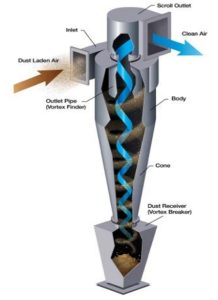
Cyclone separators are widely used in industrial processes to remove particulate matter from gas streams using centrifugal force. They are commonly applied across industries such as chemicals, metals, food processing, and power generation to control emissions and protect downstream equipment.
The need for effective particulate removal is driven by regulatory requirements, equipment protection, and process efficiency. Proper cyclone design ensures reliable performance across varying particle sizes, gas conditions, and operating environments.
Challenges
Cyclone system design presents several operational and engineering challenges:
- Variation in particle size impacting collection efficiency
- Balancing pressure drop with desired separation performance
- Handling abrasive, corrosive, or high-temperature materials
- Maintaining proper inlet velocity for optimal cyclone operation
- Preventing material buildup and internal wear
- Ensuring compatibility with upstream and downstream equipment
- Meeting environmental and safety standards for emissions control
These combined factors influence cyclone effectiveness and can lead to performance issues if not properly addressed.
Solutions
A customized cyclone separator design was implemented based on process data, particle characteristics, and system requirements.
Key elements of the solution included:
- Optimization of inlet velocity within recommended operating ranges
- Selection of cyclone configuration including parallel or series arrangements
- Detailed evaluation of particle size distribution for performance prediction
- Design of outlet pipe and cone geometry to improve efficiency
- Integration of dust receivers and airlocks to prevent leakage
- Use of appropriate materials and linings for abrasion and corrosion resistance
- Incorporation of NFPA-compliant safety and explosion protection features
The design approach was validated through established engineering practices and performance data to ensure reliable operation.
Results
Implementation of the optimized cyclone design delivered measurable improvements:
- Improved particulate removal efficiency across targeted size ranges
- Reduced loading on downstream filtration equipment
- Stable operation within defined pressure drop parameters
- Enhanced durability in abrasive and high-temperature applications
- Reduced maintenance due to minimized buildup and wear
- Compliance with environmental and emission standards
- Flexible system configurations supporting varied process requirements
Overall, the cyclone design improved system reliability, reduced emissions, and enhanced process efficiency across multiple industrial applications.
To view the full case study, please fill out the form below.