
Overview
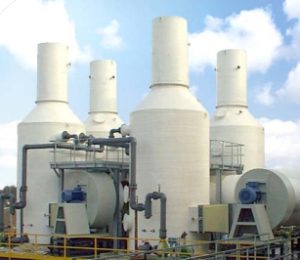
Industrial processes often generate air streams containing hazardous gases, particulate matter, and chemical vapors that must be removed before discharge. Wet scrubbers are widely used air pollution control devices that bring contaminated gas streams into contact with a liquid to remove pollutants.
These systems are commonly applied in industries such as chemical processing, metal finishing, semiconductor manufacturing, and wastewater treatment where emissions must meet strict environmental standards.
Challenges
Air pollution control applications involving gases and particulates present several challenges:
- Presence of hazardous air pollutants (HAPs) requiring high removal efficiency
- Handling soluble gases such as acids and ammonia
- Removal of fine particulate and mist droplets
- Managing corrosive chemical environments within equipment
- Achieving consistent performance across varying airflow and contaminant levels
- Controlling emissions while minimizing energy consumption
- Ensuring safe handling of potentially reactive or hazardous materials
These challenges require a solution capable of addressing both gas absorption and particulate capture in a single system.
Solutions
A wet scrubber system was implemented to capture and transfer airborne contaminants into a liquid phase for removal.
Key elements of the solution included:
- Intimate contact between contaminated air stream and scrubbing liquid
- Absorption of soluble gases into the liquid via mass transfer and chemical reaction
- Mechanical removal of particulate through impaction and collection in liquid
- Use of packed bed, spray tower, or venturi scrubber configurations
- Recirculating liquid systems with pumps and spray nozzles for consistent coverage
- Mist eliminators to remove entrained droplets from clean gas stream
- Chemical additives for neutralization and enhanced removal efficiency
The system design allows for optimization based on contaminant type, airflow, and required efficiency.
Results
Implementation of wet scrubber systems delivered measurable benefits:
- High removal efficiency for soluble gases and hazardous pollutants
- Effective capture of particulate and mist droplets
- Compliance with environmental emission standards
- Improved safety by handling pollutants in liquid form
- Flexible operation across a wide range of industrial applications
- Reduced airborne contaminant levels in exhaust streams
- Integration with downstream processes such as neutralization or recovery
Overall, wet scrubbers provide a reliable and effective method for controlling industrial emissions while maintaining operational safety and regulatory compliance.
To view the full case study, please fill out the form below.