Overview
Metal injection molding (MIM) requires precise blending of metal powders with binder systems to produce high‑precision components. Achieving uniform distribution of binders throughout the powder matrix is critical to ensure proper density and downstream molding performance.
Traditional methods can struggle to simultaneously melt binders and uniformly disperse them within a single processing step. The application required a continuous solution capable of integrating thermal and mechanical energy to achieve consistent material properties.
Challenges
MIM processing presents several operational challenges:
- Melting multiple binder components to the appropriate phase
- Achieving uniform dispersion of binders within metal powder
- Maintaining consistent product density for precision molding
- Handling high metal powder loading (approximately 85%)
- Integrating melting and mixing in a single processing step
- Ensuring sufficient shear without degrading material properties
- Maintaining process flexibility for variable operating conditions
These challenges directly impact part quality, consistency, and production efficiency.
Solutions
A continuous processing system was implemented to simultaneously melt and uniformly disperse binder materials into metal powders.
Key elements of the solution included:
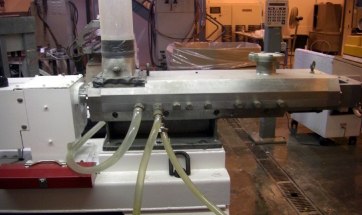
- Heated mixing chamber enabling binder phase change during processing
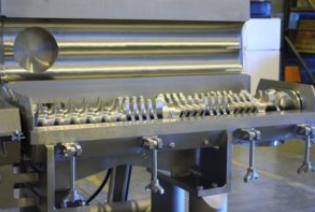
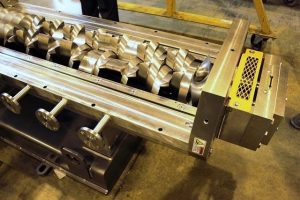
- Twin‑shaft continuous processor providing controlled shear and mixing
- Configurable paddle arrangement to optimize melting and dispersion
- Integration of thermal energy and mechanical mixing in one chamber
- Variable shaft speed control for process flexibility
- Progressive mixing zone allowing initial melting followed by final homogenization
- Continuous operation reducing process variability
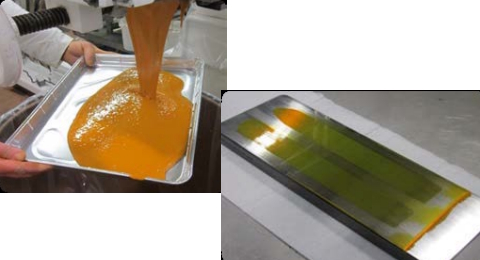
The system allowed binders and powders to be combined into a fully homogeneous mixture suitable for injection molding.
Results
Implementation of the continuous processing system delivered measurable improvements:
- Achieved uniform dispersion of binders within metal powder
- Improved product density and consistency
- Reduced number of processing steps by combining melting and mixing
- Increased process efficiency through continuous operation
- Improved control over shear and material flow
- Reduced variability in downstream molding performance
- Simplified system design with fewer pieces of equipment
Overall, the solution improved material consistency and processing efficiency in metal injection molding applications.
Related Solutions
- Continuous mixing and processing systems for high‑viscosity and filled materials
- Dust collection systems for control of fine powders in material processing
- Particle size reduction systems for preparation of metal powders and additives
To view the full case study, please fill out the form below.