
Overview
Modified asphalt production requires uniform incorporation of additives such as rubber pellets and oils to enhance performance characteristics. These processes traditionally rely on large batch systems operating at elevated temperatures for extended periods.
Maintaining high temperatures and long processing times can lead to excessive energy consumption and inefficiencies in production. The application required a solution capable of rapidly dispersing additives while reducing processing time and energy use.
Challenges
Asphalt modification processes present several operational challenges:
- Long batch processing times required to fully disperse additives
- High energy consumption from maintaining temperatures above 300°F
- Large tank systems requiring significant space and capital investment
- Inconsistent product quality due to extended mixing cycles
- Excess work-in-process inventory due to batch operation
- Multiple processing steps increasing complexity
- Difficulty achieving rapid, uniform dispersion of fillers and additives
These challenges increase operating costs and reduce production flexibility.
Solutions
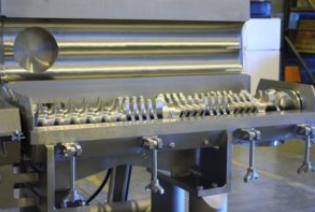
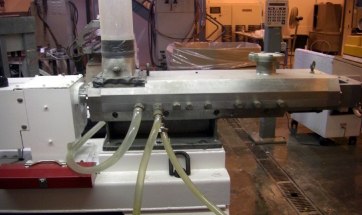
A continuous processing system was implemented to rapidly dissolve and disperse additives into asphalt with minimal residence time.
Key elements of the solution included:
- Continuous processor design eliminating traditional long batch cycles
- Ability to dissolve and disperse additives in less than five minutes
- Dual processor configuration reducing the need for large heated storage tanks
- Customizable paddle arrangement for optimized mixing and dispersion
- Controlled operating conditions including shaft speed and temperature
- Compact system footprint compared to conventional tank systems
- Reduced process steps through integrated continuous operation
The system enables efficient processing while maintaining consistent product quality and significantly reducing energy usage.
Results
Implementation of the continuous processing system delivered measurable improvements:
- Reduced processing time from over five hours to less than five minutes
- Lower energy consumption due to reduced heating requirements
- Improved product consistency through rapid, controlled dispersion
- Reduced footprint by eliminating large batch tanks
- Decreased work-in-process inventory with on-demand production capability
- Simplified processing with fewer steps and less equipment
- Increased operational flexibility with continuous production
Overall, the solution improved efficiency, reduced energy use, and enhanced product quality in modified asphalt processing.
RELATED SOLUTIONS
- Continuous mixing and processing systems for slurry and viscous materials
- Dust collection systems for control of fines in material handling operations
- Particle size reduction systems for preparing additives and fillers
To view the full case study, please fill out the form below.