Overview
Processors across food, chemical, and industrial sectors require reliable methods to convert liquid feedstocks into dry powder products. These applications demand consistent particle size, controlled moisture levels, and high product quality.
Conventional drying methods may result in uneven drying, product degradation, or inefficient processing. The application required a system capable of rapid evaporation, controlled particle formation, and scalable production capacity.
Challenges
Drying liquid materials into powder presented several processing challenges:
- Achieving consistent particle size and morphology
- Preventing product degradation from excessive heat exposure
- Managing different feed viscosities and compositions
- Controlling moisture content in finished product
- Handling fine powders and preventing dusting issues
- Need for high-capacity drying with continuous operation
- Maintaining efficiency across varying product formulations
These issues made it difficult to maintain consistent quality while achieving efficient large-scale production.
Solutions
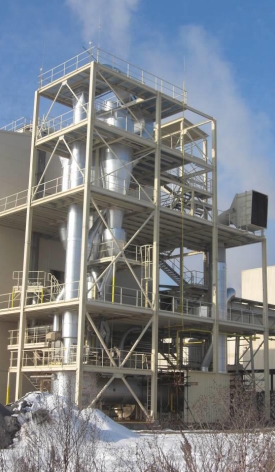
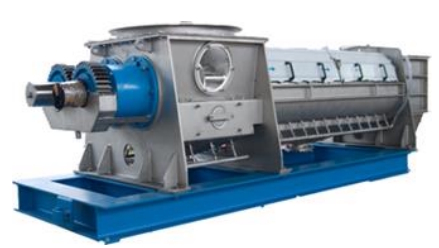
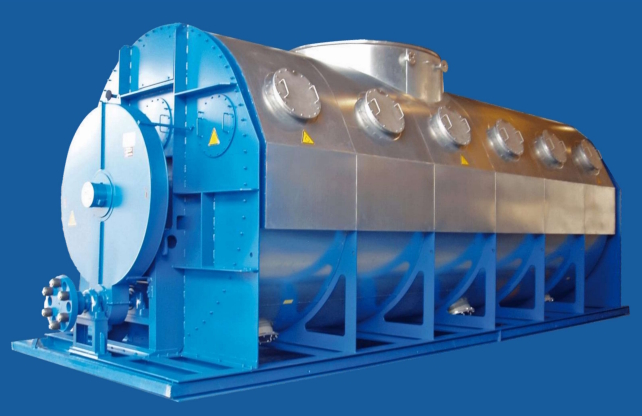
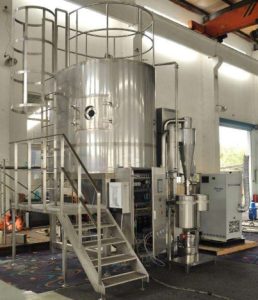
A spray drying system was implemented using atomization and controlled hot air flow to produce uniform powder particles.
Key elements of the solution included:
- Atomization of liquid feed into fine droplets using nozzle or rotary technology
- Co-current hot air flow for rapid evaporation and short residence time
- Separation of dried particles from gas stream for product recovery
- Flexible system configurations including single-, two-, or three-stage drying
- Integration of cyclones, bag filters, and fluid beds for product finishing
- Capability to process a wide range of materials, from food to chemicals
- Optional heat recovery systems to enhance energy efficiency
The system performance was validated through scalable designs and proven installations across multiple industries.
Results
Implementation of the spray drying system delivered measurable improvements:
- Efficient conversion of liquid feed into uniform powder
- High evaporation capacity supporting large-scale production
- Controlled particle size and powder characteristics
- Reduced thermal exposure due to short residence time
- Increased process flexibility across multiple product types
- Improved product quality and consistency
- Enhanced operational efficiency with continuous processing
Overall, the system provided reliable and scalable drying performance while maintaining product quality and process efficiency.
To view the full case study, please fill out the form below.