Overview
Industrial processors require efficient drying of wet cakes, sludge, and fibrous materials across industries such as starch, ethanol, food, and chemicals. These applications demand consistent moisture reduction while maintaining product quality and minimizing energy consumption.
Conventional drying methods can introduce high emissions, excessive energy use, and product degradation. The application required a solution capable of delivering gentle drying, high throughput, and reliable operation across a wide range of materials.
Challenges
Drying operations presented several process and operational challenges:
- High moisture content in wet cakes and fibrous materials
- Risk of product degradation at elevated drying temperatures
- Energy inefficiency in conventional drying systems
- Need to reduce emissions and comply with environmental regulations
- Variability in material characteristics affecting drying performance
- Integration of drying systems into existing process lines
- Requirement for high-capacity evaporation rates
These combined challenges reduced efficiency and increased operational costs while limiting process reliability.
Solutions
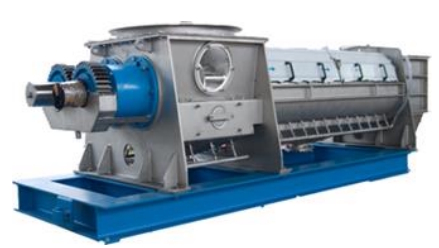
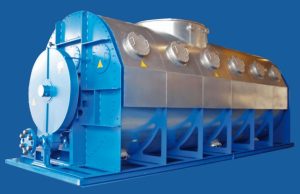
An indirect steam-heated tube bundle dryer was implemented to provide efficient, gentle, and high-capacity drying.
Key elements of the solution included:
- Indirect steam heating system allowing flexible energy source selection
- Combination of contact and convective drying mechanisms
- Rotating tube bundle enabling continuous material transport and heat transfer
- Low-temperature drying to preserve product quality
- Modular design enabling simplified installation and system integration
- Gas-tight operation with integrated filtration for low emissions
- Energy recovery capability up to 90%
The system design and performance were validated through proven installations and operational data across multiple industries.
Results
Implementation of the tube bundle dryer delivered measurable operational improvements:
- High evaporation capacity with systems exceeding 10+ tons per hour water removal
- Reduced energy consumption through steam-based indirect heating
- Lower emissions with integrated filtration achieving low dust levels
- Improved product quality due to gentle, low-temperature drying
- Increased system reliability with robust mechanical design
- Flexible operation across a wide range of materials and industries
- Enhanced process efficiency with continuous and stable drying performance
Overall, the system improved drying efficiency, reduced environmental impact, and supported high-throughput industrial processing.
To view the full case study, please fill out the form below.