
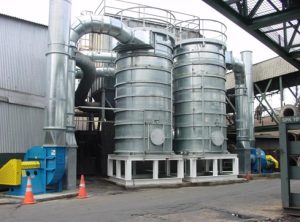
Overview
Mist elimination systems are used in industrial processes to remove fine liquid droplets from gas streams, including aerosols formed through chemical reactions, condensation, and mechanical shearing. These systems play a critical role in air pollution control and process efficiency.
In many applications, mist particles are extremely small—often less than one micron—making separation challenging. The application requires technologies capable of capturing these fine droplets while maintaining acceptable pressure drop and system performance.
Challenges
Mist and aerosol removal systems must address several technical challenges:
- Capturing submicron droplets formed from condensation and chemical reactions
- Handling varying droplet sizes from less than 1 micron to several microns
- Managing high gas velocities without excessive pressure drop
- Preventing carryover of liquids into downstream equipment
- Maintaining long filter life in corrosive or high-temperature environments
- Designing systems for both new installations and retrofits
- Integrating with ductwork and broader air handling systems
These challenges directly affect emissions, equipment reliability, and operational performance.
Solutions
A mist elimination system using fiber bed and mesh pad technologies was implemented to remove liquid aerosols from process gas streams.
Key elements of the solution included:
- Fiber bed (candle) filters capable of capturing submicron droplets
- Mesh pad mist eliminators for removal of larger droplets
- Multi-layer “graded bed” media design for optimized filtration performance
- Collection mechanisms including impaction, interception, and Brownian diffusion
- Custom system configurations including filter-in-vessel and duct-mounted systems
- Materials of construction selected for chemical and temperature compatibility
- Turnkey systems with blowers, ducting, and controls
These systems allow efficient separation of liquid droplets across a wide particle size range.
Results
Implementation of the mist elimination system delivered measurable benefits:
- Effective removal of fine aerosol droplets from gas streams
- Reduced liquid carryover to downstream equipment
- Lower pressure drop with optimized media design
- Extended filter life with multi-layer filtration systems
- Reduced maintenance requirements in process systems
- Reliable performance across a wide range of industrial applications
- Consistent operation in continuous processing environments
Overall, the system supports emission control and process reliability in gas handling applications.
Related Solutions
- Cyclone separation systems for upstream particulate removal in air streams
- Industrial ductwork systems for airflow transport and system integration
- Regenerative thermal oxidizer systems for VOC and emissions control
To view the full case study, please fill out the form below.