
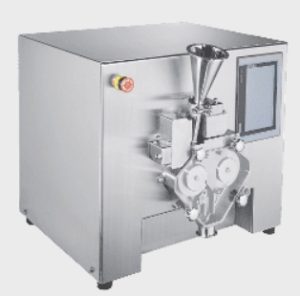
Overview
Dry granulation through roll compaction is a critical process in pharmaceutical and fine chemical manufacturing, enabling conversion of poorly flowing powders into uniform granules. This improves material handling, blending, and downstream processing such as tablet compression.
Traditional powder handling can be challenging due to poor flowability and inconsistent bulk density. The application required a solution capable of densifying powders and producing uniform granules in a continuous, controlled process.
Challenges
Powder processing and granulation present several operational challenges:
- Poor flowability of fine powders
- Inconsistent bulk density affecting downstream processing
- Entrained air causing instability during compaction
- Achieving uniform particle size distribution after granulation
- Controlling compaction pressure and material densification
- Integrating granulation with milling and downstream equipment
- Maintaining reproducibility and process consistency
These challenges affect overall process efficiency, product quality, and production stability.
Solutions
A roll compaction system was implemented to densify powders and produce uniform granules in a continuous process.
Key elements of the solution included:
- Controlled feed system with metering screw for consistent material input
- Pre‑compression screw for deaeration and improved powder handling
- Counter‑rotating rolls applying controlled pressure to form compacted ribbons
- Precise roll gap control to ensure consistent product density
- Hydraulic system maintaining uniform compaction force
- Integrated milling system to convert ribbons into granules
- Continuous operation for improved efficiency and reproducibility
The system converts fine powders into free‑flowing granules, improving downstream processing performance.
Results
Implementation of the roll compaction system delivered measurable improvements:
- Improved powder flowability and handling
- Enhanced uniformity in particle size distribution
- Increased bulk density for better downstream processing
- Reduced variability in tablet manufacturing
- Improved process consistency and repeatability
- Reduced need for wet granulation and drying steps
- Increased overall process efficiency
Overall, the solution enhanced material conditioning and enabled more efficient pharmaceutical production.
Related Solutions
- Particle size reduction and milling systems for preparation and conditioning of materials
- Dust collection systems for control of fines during material transfer
- Screening systems for final product separation and quality control
To view the full case study, please fill out the form below.